Jack Ward

Hi, I'm Jack

I'm Jack Ward, a second-year MEng Electrical and Electronic Engineering with Management student at Imperial College London.

I'm interested in electronics, particularly analogue circuit design, and I enjoy hands-on hardware work. My experience covers circuit analysis and simulation in LTspice, prototyping and soldering, PCB assembly, and debugging on the bench with an oscilloscope.

Outside my degree I build my own electronics projects, such as a hand-tracking pan-tilt turret with ultrasonic 3D scanning. I also enjoy working in teams, most recently on a six-person lunar rover, where I was responsible for the RF sensing.

I'm familiar with C++, Python, Verilog, LTspice and Microsoft Office, and I'm looking for a summer 2027 internship in electronics and hardware.

London, United Kingdom GitHub LinkedIn

Selected work

Projects

EEE Lunar Rover

A Wi-Fi-controlled rover, built in a team of six, that surveys an artificial lunar surface and classifies rocks by age and type using RF, ultrasonic, infrared and magnetic sensing. I was responsible for the RF sensing, which decodes each rock's age.

  • Designed and simulated the RF receiver in LTspice: a tuned coil antenna, amplifier, envelope detector and comparator for an 89 kHz ASK signal
  • Built and debugged the receiver chain on hardware with an oscilloscope, retuning the comparator threshold where measurements differed from simulation
  • Integrated the RF channel alongside the ultrasonic, infrared and magnetic sensing circuits on the rover
  • Co-wrote the technical report and presented the design and results to assessors
Jun – Jul 2026

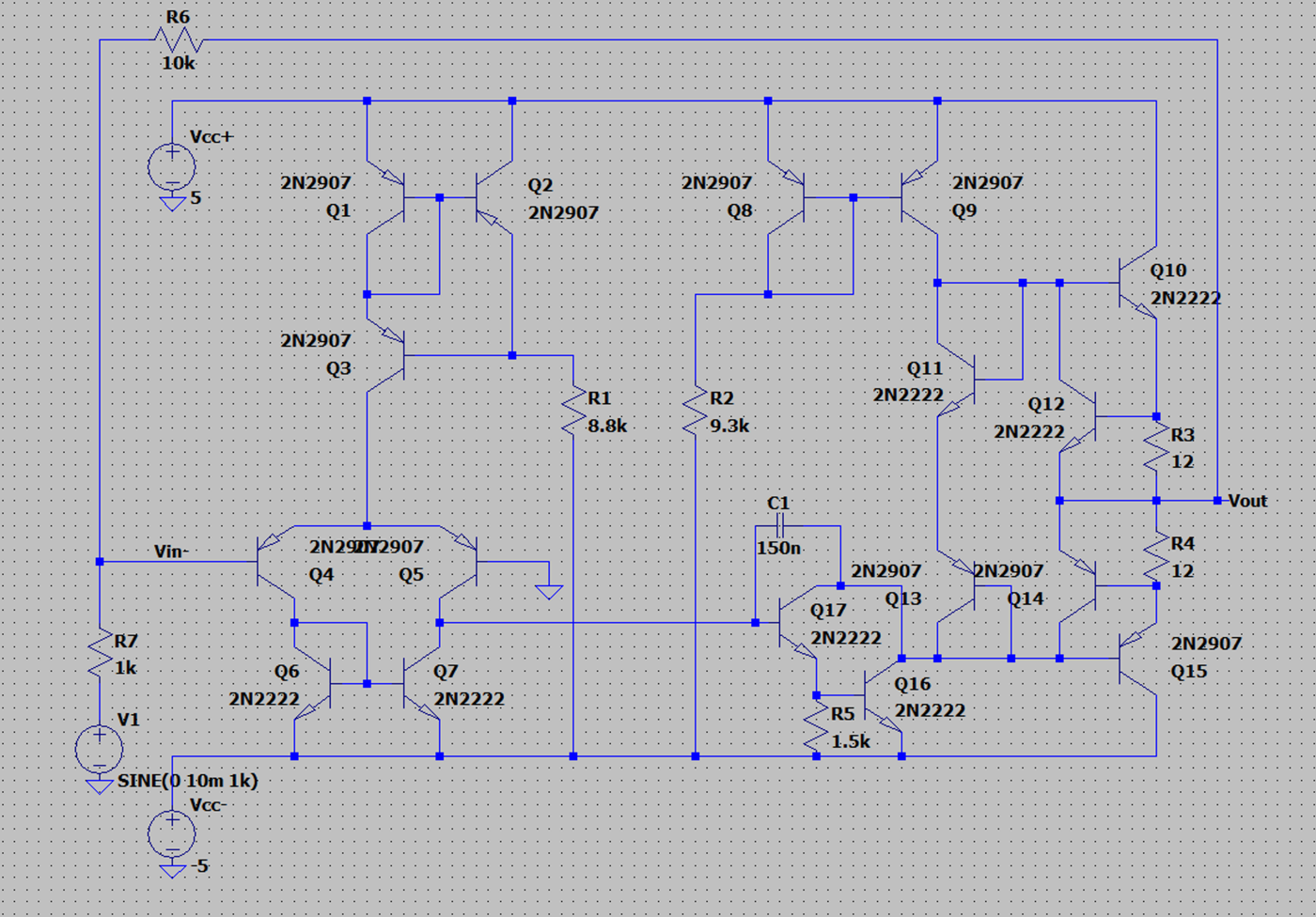
Discrete BJT Operational Amplifier

A three-stage operational amplifier designed entirely from discrete BJTs in LTspice, achieving 118 dB open-loop gain on a ±5 V supply.

  • Designed a long-tailed pair differential input stage with a Wilson current mirror active load for high differential gain, low common-mode gain and improved CMRR
  • Implemented a common-emitter gain stage with a current mirror active load to boost voltage gain
  • Developed a class AB push-pull output stage to increase output current and reduce crossover distortion
  • Diagnosed high-frequency instability from a negative phase margin in AC analysis, then stabilised it with a compensation capacitor across the common-emitter stage
  • Achieved 118 dB open-loop gain, and verified the design as an inverting amplifier with a closed-loop gain of 10.1 against a theoretical 10
Jan – Mar 2026

Robot Hand Turret

A pan-tilt turret steered by hand gestures that doubles as a 3D ultrasonic scanner.

  • Assembled a two-axis pan-tilt servo rig that follows a user's hand movement in real time
  • Tracked hand position with MediaPipe, mapping wrist coordinates to pan and tilt angles sent to an Arduino over serial
  • Mounted an HC-SR04 ultrasonic sensor on the head, streaming distance readings to a live radar view
  • Swept the sensor across a grid of angles, plotting the readings as a 3D point cloud in Python
Aug – Sep 2026

16-bit RISC CPU Datapath in Verilog

The datapath of a 16-bit RISC CPU, the part of the processor that stores, moves and calculates data, written in Verilog as an extension of my Computer Architecture lab.

  • Built on my Computer Architecture lab work by implementing the datapath of a 16-bit RISC CPU in Verilog from a lab schematic design
  • Designed an 8-operation ALU sharing one adder for all arithmetic, with a 4-stage barrel shifter
  • Verified the ALU with a self-checking testbench across 100,000 randomised tests with zero mismatches
  • Executed machine-code programs in simulation, including 32-bit addition using the carry flag
Mar 2026

Fantasy Premier League Model

AI-assistedBuilt with AI coding tools: I came up with the idea and features, directed the build and tested the result.

An expected-points model, player index and squad optimiser for Fantasy Premier League, built by modelling each scoring rule the way it actually works.

  • Modelled each player's expected points from eight scoring components, including minutes, goals, assists, clean sheets, defensive contributions and bonus
  • Built an index of every player in the game, ranked by model rating, expected points, price and ownership, searchable and filterable by position, with a confidence marker for players with little data
  • Selected the best 15-player squad within budget using integer linear programming, optimising for league rank rather than total points
Aug 2026

Middle-earth Flythrough

AI-assistedBuilt with AI coding tools: I came up with the idea and features, directed the build and tested the result.

A Google Earth-style 3D map of Tolkien's Middle-earth that you can fly through in the browser.

  • Processed a 50 m elevation model of 1.6 billion pixels into 3.75 GB of streamed terrain tiles with GDAL and Python
  • Converted 26 map layers, including rivers, roads, realms and Frodo's route, into vector tiles with ranked town labels
  • Rendered the map in MapLibre with 3D terrain, hillshading, elevation colouring and layer toggles

Map data: Rose, R. A. (2020), GIS & Middle Earth, William & Mary Center for Geospatial Analysis, CC BY-NC-SA 4.0.

Aug 2026

Waypost: Trip Journal App

AI-assistedBuilt with AI coding tools: I came up with the idea and features, directed the build and tested the result.

A travel-journal app for iPhone and Android that turns the photos from a trip into albums, a map of where you went and storyboards to look back on.

  • Albums: import photos from your camera roll into trip albums, shown as polaroid-style cards you can caption
  • World map: reads each photo's GPS location and time, groups photos taken within 5 km of each other into stops, and plots every trip's stops on a world map in the order you visited them
  • Storyboards: choose photos and write a caption for each page to build a flip-through story of a trip, saved on your phone to replay later
  • Built in Expo (React Native) and TypeScript, using native maps and the phone's photo library
Jun – Jul 2026